They have designed an amazing new clay-based, interlocking brick that is waterproof, fireproof, insect-proof, soundproof, mold and mildew-proof, insulates the home, saves energy and best of all; it's the greenest construction material that exists on the market today.
Their system allows homes to be built faster and stronger. Rather than bond the bricks with mortar, they use a construction adhesive (much like liquid nails) which bonds to the brick, not just sticks to it. Once the bricks are glued together, they form a monolithic wall, much like a poured concrete wall.
The clay in their bricks is treated with a non toxic, environmentally friendly chemical that neutralizes the polarity of the clay molecule, making the clay essentially waterproof because there is no electrical charge to attract and hold the water molecule.
Mowing the lawn doesn't have to involve smelly noisy lawn mowers. It can be a sleek and quiet operation. ECO Mowers has an extensive learning section teaching about the impact of mowing the lawn, plus the products they've lined up to help you do it a better way.
Most of the products they have are reel motors, so yeah it will involve manual effort.
They also carry electric mowers and other gizmos for low impact yard care.
Glumac provides consulting engineering for four market segments - Mechanical, Electrical and Plumbing (MEP) consulting engineering services. Our Sustainable Design, Information Technology, and Commissioning Services are key to enhancing our their capabilities. Their difference is in having LEED Accreditied Professionals on every project.
A membership-based professional organization which provides educational resources to planners, suppliers, and venues seeking to meet the ever-rising standards consumers set for sustainable meetings. They promote green practices globally by offering educational programs in the form of training workshops and online resources. The Council is in the process of partnering with educational institutions to develop an accredited curriculum at the university level for green meetings.
You are missing some Flash content that should appear here! Perhaps your browser cannot display it, or maybe it did not initialize correctly.
In the C-Realm Podcast episode #124 is an interview with Toby Hemenway which has several interesting thoughts in it. The interview was drawn heavily from his article Apocalypse, NOT. They were discussing "the end of the world as we know it" (TEOTWAWKI) and the likelihood of the collapse of our society due to the various crises facing us.
While listening a question came clearly to mind ... If we are to have the world we want, is it necessary to have our society collapse? Do we need to erase our existing society and start over with a new one? Alternatively is it possible to build the society we want to have, while in the context of the society we're living in?
I think most of us want to live in a better place. There are many versions of what would be a "better" society, right? Different people have their own ideas of "better" society, "better" living conditions, "better" political structures, etc.
Toby Hemenway is a Biologist turned Permaculturist. He discussed the danger of the "growth economy" and how the "growth economy" needs to die, in his view. The "growth economy" is the requirement that companies and population is always growing, enforced by the stock market which gives high value to growing companies and death sentences to those who aren't. He also discussed the "solar budget" and the need for our society to live within the solar budget, meaning that the resources our society consumes ought to be constrained by the energy which can be converted from sunlight.
In any case he has a clear preference for "better" which he described as a horticultural based society rather than agricultural.
There are many people who are predicting doom and gloom and a collapse of our society. I am a student of peak oil and am familiar with the peak oil thinking, that pretty darn soon the oil supply is due to enter into a decline which will cause a crisis to our society over how to make up the difference between demand and supply for the fuel to drive our machines.
Maybe the collapse will be as bloody as depicted in some of the movies such as the Mad Max trilogy. Or maybe it will be smoother.
The desire for "better" stems from unhappiness with the status quo, fear of where the status quo is leading our society, and a vision we have for the better society of our dreams.
It seems to me we can choose for ourselves to live in alignment with our vision of a better society. Depending on our individual vision it may be simple to accomplish or hard.
History is full of clusters of people who set up communal living situations in which they could experiment with developing a vision of a "better" way to live. Today these are called "Intentional Communities" and they vary in size from the big ones like Damanhur or Findhorn down to small groups. These communities have existed all through human history with varying success.
These people have been able to experiment but it still leaves people like me concerned about the direction the status quo is leading our society. These experiments have perhaps been good for the people involved, but they've had little effect on the status quo, and the status quo appears to be leading us all to disaster.
At some points our experiments in better lifestyles ought to become mainstream to make the lessons learned from these experiments to have a broad effect.
In many parts of the world access to clean water is a key problem. Water purification is the process of removing undesirable chemical and biological contaminants from raw water. The goal is to produce water fit for human consumption or other specific purposes. In general the methods used include physical process such as filtration and sedimentation, biological processes such as slow sand filters or activated sludge, chemical process such as flocculation and chlorination and the use of electromagnetic radiation such as ultraviolet light. The purification process of water may reduce the concentration of particulate matter including suspended particles, parasites, bacteria, algae, viruses, fungi; and a range of dissolved and particulate material derived from the minerals that water may have made contacted after falling as rain.
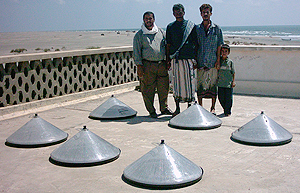
Water purification can be an energy intensive process and there has been a long quest for effective purification methods. For example boiling water, capturing and condensing the steam, requires an energy input required to boil water. If the energy comes from a fuel like oil or coal there is the addition of carbon emissions from burning the fuel. It also would tie the need for water to consumption of a nonrenewable resource like fossil oil or coal. The Watercone is a very simple way to purify water that uses sunlight as the energy to boil the water.
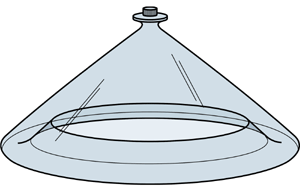
The cone is placed over a pan containing water. The pan should be black for best heat absorption. The cone has a trough along the inside rim to catch water. Water evaporates from the pan, moves upward, is caught on the inside of the cone, then drips down to the trough. So simple.
The WATERCONE(r) system can be referred to as a one step water condensation process with a 40% effectiveness degree (GTZ Germany). Based on evaporation levels of 8.8 Liters per square meter (average solar irradiation in Casablanca, Morocco), the WATERCONE(r) (with a base diameter of 60 - 80 cm) yields between 1.0 to 1.7 Liters of condensed water per day (24 hours). The salty / brackish Water evaporates by way of solar irradiation and the condensation from that Water appears in the form of droplets on the inner wall of the cone. These droplets trickle down the inner wall into a circular trough at the inner base of the cone.
I like many things about this design. It is simple and easy to understand. However the implementation is made from PVC plastic, and it contributes to more plastic existing in the world. Pondering a different way to implement this design in my mind I see a glass cone rather than a plastic cone and perhaps it can be a little bigger.


 Water purification can be an energy intensive process and there has been a long quest for effective purification methods. For example boiling water, capturing and condensing the steam, requires an energy input required to boil water. If the energy comes from a fuel like oil or coal there is the addition of carbon emissions from burning the fuel. It also would tie the need for water to consumption of a nonrenewable resource like fossil oil or coal. The Watercone is a very simple way to purify water that uses sunlight as the energy to boil the water.